
How closely can two wearers' cameras be aligned?
Two wearers who exit the same aircraft on the same pass were aligned after capture from a shared exit call: an offset of 8.951 s, applied as 268 frames, puts the cameras within 2 frames (67 ms) at the exit. The offset was measured at the exit; drift later in the jump was not measured.
The recording
Two wearers exit the same aircraft on the same pass, each with a camera, aligned after capture from a shared exit call. At the door one camera sees the other wearer, at the moment that wearer's own camera shows the door. Wearer B's view is a 360 degree camera reframed to portrait before publication, so it mostly looks back at its wearer. Markings and faces are obscured.
Alignment: aligned after capture from a shared exit call; within 2 frames (67 ms) at the exit.
One moment in both cameras
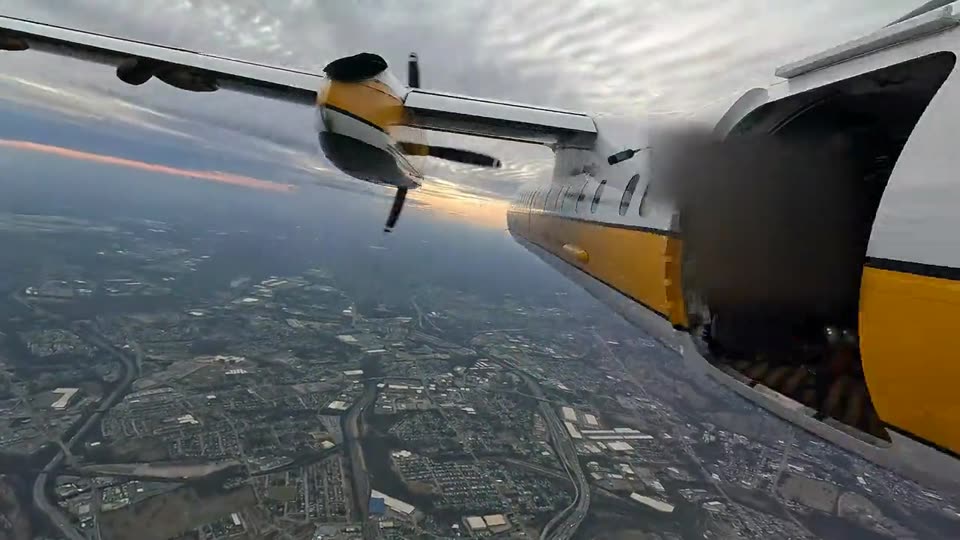 Head camera, frame 72 (2.40 s)
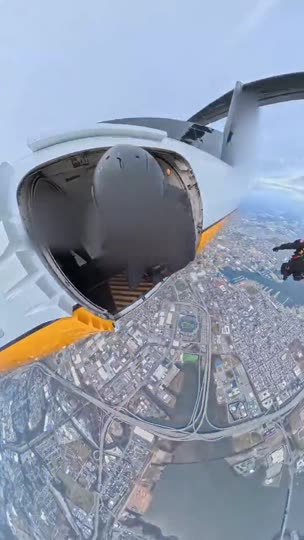 Helmet camera, frame 72
“Point-of-view videos 990124 and 990123” by U.S. Department of War, via DVIDS. Public domain. Trimmed, aligned, masked and re-encoded by ONME. The appearance of U.S. Department of War (DoW) visual information does not imply or constitute DoW endorsement.
Research uses
- Multi-person 3D pose and tracking: EgoHumans: An Egocentric 3D Multi-Human Benchmark (arXiv 2305.16487) holds 7 sequences from 20 subjects across basketball, fencing, badminton, tennis and volleyball, with two to four players wearing camera glasses and 8 to 15 fixed cameras.
- Partner pose from a wearer's view: EgoBody: Human Body Shape and Motion of Interacting People from Head-Mounted Devices (arXiv 2112.07642) defines partner pose from one head-mounted wearer recording an interaction partner. With several wearers, each could serve as the other's observer (our reading).
- Scenes rebuilt from several recordings at once: Aria Everyday Activities includes 53 sequences in which two wearers recorded at the same time, with timestamps on a shared clock and positions in one coordinate frame per location (Aria Everyday Activities Dataset, arXiv 2402.13349).
- Shared mapping across agents: COVINS has run with 12 agents jointly performing SLAM, on 12 simulated drone flights over a photo-realistic village model replayed in real time (COVINS: Visual-Inertial SLAM for Centralized Collaboration, arXiv 2108.05756).
What a recording needs
- Unrelated first-person clips are not multi-egocentric data. Frames can be matched across wearers only with a shared clock or a measured alignment, such as a sound both cameras recorded, with its error stated; positions can be compared only once recordings are registered in one frame. Ask for wearer IDs and the timing method with the footage.
- Aria Gen 2 glasses compute the time offset between devices from a sub-GHz radio broadcast, with a measured offset error under 10 microseconds within 30 m indoors and 100 m outdoors. The documentation notes that this does not synchronise the devices. Source: Aria Gen 2 hardware specification.
- Project Aria's multi-recording service places recordings of the same space in one coordinate frame. It does not synchronise their timestamps, and recordings it cannot connect stay in separate frames. Source: Aria multi-SLAM output format.
- In the clip analysed in this note the aircraft moves against a distant ground and one view is a reframed 360 degree camera, and ONME's attempt to place the pair in one 3D map failed a cross-projection check. It is shown as synchronised video with no shared geometry.
- Placing long recordings of one space in a shared coordinate system can be hard: the Aria Everyday Activities authors say so, and their recordings include moving people. Every wearer, and the people they film, need to consent.
Where the format matters in sport
| Football | No published football study we found aligns several players' head or eye cameras in time. The closest, an eye-tracking study of four elite midfielders in a training match and a friendly, reports each player's recording separately, 10 to 20 minutes each, with 869 scans in total, and does not align or compare their views. Source: Scanning activity of elite football players in 11 vs. 11 match play, PMC8378692. |
|---|---|
| Badminton | EgoHumans shows the setup that comparing players' views of one rally needs: badminton among its sports, with two to four players wearing camera glasses and 8 to 15 fixed cameras, in 7 sequences from 20 subjects across all sports. Source: EgoHumans: An Egocentric 3D Multi-Human Benchmark, arXiv 2305.16487. |
| Road cycling | Several riders' views of one peloton formation would show the same interaction from inside; no multi-wearer cycling capture was found for the ±30 degree alignment the study linked below describes. Source: How vision governs the collective behaviour of dense cycling pelotons, PMC6685023. |
Limits
The offset was measured at the exit, and drift later in the jump was not measured. The pair shares a clock and no geometry: the attempt to place both cameras in one 3D map failed.
Sources
- EgoHumans: An Egocentric 3D Multi-Human Benchmark, arXiv 2305.16487Read
- EgoBody: Human Body Shape and Motion of Interacting People from Head-Mounted Devices, arXiv 2112.07642Read
- Aria Everyday Activities Dataset, arXiv 2402.13349Read
- COVINS: Visual-Inertial SLAM for Centralized Collaboration, arXiv 2108.05756Read
- Aria Gen 2 hardware specificationRead
- Aria multi-SLAM output formatRead
- Scanning activity of elite football players in 11 vs. 11 match play, PMC8378692Read
- How vision governs the collective behaviour of dense cycling pelotons, PMC6685023Read
- DVIDS copyright and restrictionsRead