
Sports datasets
First-person, external and synchronised camera views for AI research.
Dataset formats
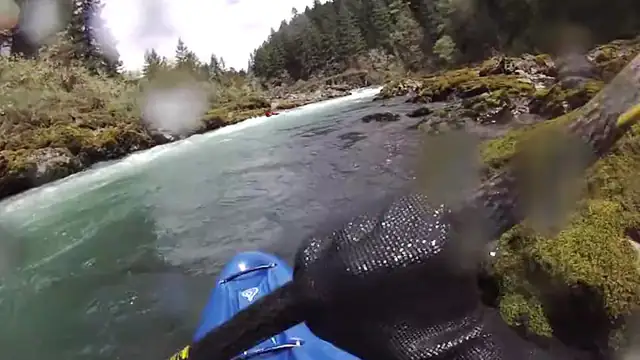
A helmet camera on whitewater. Both hands, the paddle and the bow stay in view at close range, and the whole image swings with the wearer's head. Head direction is not gaze: where the eyes pointed needs eye-tracking cameras.
Public footage, not ONME data.
“Whitewater kayaking on the North Umpqua River” by BLM Oregon & Washington, via Flickr. CC BY 2.0. Trimmed to 12 s, cropped, scaled and re-encoded without audio by ONME.
- Camera
- One worn camera or a camera fixed at the driver’s eye line.
- View
- Hands, nearby objects and other people from the wearer’s viewpoint.
- Useful for
- First-person action and hand-object interaction.
A tripod camera sees the whole rider and bike come down rock ledges: body position, bike path and ground in one frame, which a camera on the rider's helmet cannot show. Where the rider looked is not recorded.
Public footage, not ONME data.
“Technical Hardtail riding [ all mountain / enduro ]” by Radde faehrt Radd (YouTube channel), via Wikimedia Commons. CC BY 3.0. Trimmed to 10 s and re-encoded without audio by ONME.
- Cameras
- One or more fixed cameras around a court, pitch, track or training area.
- Timing
- Timing and calibration are checked against the requested tolerance.
- Useful for
- Whole-body movement, participant tracking and activity context.
Two global-shutter cameras 109.5 mm apart on a cyclist's helmet, shown after ONME rectified them with the published calibration, on a daytime ride along campus paths. Compare objects at different distances: the railing beside the path shifts more between the two views than the building facade, and that shift is what gives depth. The bicycle and the rider are out of view; the sport shows in the motion.
Public research footage, not ONME data.
“TUM-VIE: The TUM Stereo Visual-Inertial Event Dataset, sequence bike-easy” by Simon Klenk, Jason Chui, Nikolaus Demmel and Daniel Cremers, via the TUM-VIE dataset page. CC BY 4.0. Trimmed, rectified and re-encoded by ONME. The raw view is trimmed, resized and re-encoded only.
No endorsement by the dataset's creators is implied.
- Cameras
- Two synchronised cameras mounted a small distance apart on one wearer.
- View
- Overlapping first-person images with calibration for stereo geometry.
- Useful for
- Depth estimation near the wearer and hand-object interaction.
Two wearers exit the same aircraft on the same pass, each with a camera, aligned after capture from a shared exit call. At the door one camera sees the other wearer, at the moment that wearer's own camera shows the door. Wearer B's view is a 360 degree camera reframed to portrait before publication, so it mostly looks back at its wearer. Markings and faces are obscured.
Public footage, not ONME data.
“Point-of-view videos 990124 and 990123” by U.S. Department of War, via DVIDS. Public domain. Trimmed, aligned, masked and re-encoded by ONME.
The appearance of U.S. Department of War (DoW) visual information does not imply or constitute DoW endorsement.
- Wearers
- Two or more participants record the same session from their own viewpoints.
- Timing
- Matching timestamps and wearer IDs align every first-person stream.
- Useful for
- Comparing what participants could see during the same action.
- Cameras
- A worn camera and external cameras record the same drill or activity.
- Timing
- The first-person and external streams will share measured synchronisation.
- Useful for
- Relating a participant’s view to body movement and activity context.
Frames from a helmet camera on a track cycling ride on the left, and on the right the camera path and sparse 3D points ONME reconstructed from them, seen from above and appearing as they are first seen; the clip opens 3 s into the excerpt, with points already drawn. Points are coloured by height above the infield floor, from dark blue at 0 m to orange at 9 m and above, and the roof is hidden. Riders ahead are left out because they move. This is a reconstruction, not a simulation: it has no surfaces and no physics.
ONME computation from Indoor cycling on the velodrome of Alkmaar, Netherlands. W. Gopro hero3 black, not ground truth.
“Indoor cycling on the velodrome of Alkmaar, Netherlands. W. Gopro hero3 black” by Patrick Savalle, via Wikimedia Commons. CC BY 3.0. Excerpt 8:28 to 8:50, resized, audio removed, advertising, stands and infield blurred; 3D reconstruction by ONME.
- Inputs
- Recorded camera paths, scene observations and human motion.
- Output
- Reconstructed geometry or a simulation prepared for an agreed system.
- Useful for
- Repeatable testing, new viewpoints and synthetic task variation.
How a request works
Describe the work
Choose a format and tell us the sport, session, hours and intended use.
Review a sample
We check what can be sourced or recorded and share a representative sample when footage is available.
Agree delivery
We confirm capture, timing, labels, review criteria and delivery before work begins.
What a delivery can include
- Video
- The agreed viewpoints, session structure, duration, resolution and frame rate.
- Timing and calibration
- Synchronisation and camera calibration when the selected format needs them.
- Labels
- Unlabelled video, temporal labels, or participant and object tracks with timestamped events.
- Review and delivery
- A representative sample, agreed checks and delivery details for the project.
Availability, capture work and review requirements shape each quote.